Benazir Income Support Programme (BISP) continues to play a vital role in supporting low-income families across Pakistan. Millions of people depend on the BISP 8171 service to check eligibility and receive financial assistance. Unfortunately, the rising popularity of the programme has also given rise to fake websites and scams misusing the “8171” name.
These fraudulent platforms trick people into sharing their CNIC numbers, mobile details, and even financial information, putting families at risk of identity theft and financial fraud. To stay safe, it’s important to understand how these scams work, recognize warning signs, and rely only on official BISP portals and helplines. This article will help you protect your information while safely checking your eligibility online.
Why Fake “BISP 8171” Websites Are Exploding
In 2025, thousands of people search daily for BISP 8171 updates, payments, and eligibility checks. Scammers take advantage of this high demand by creating fake websites that look like the official BISP portal. Since many people are not familiar with online security, they easily trust these sites and enter their CNIC numbers without thinking twice.
Fraudsters also spread these fake links through Facebook, WhatsApp, and YouTube to reach a wider audience quickly. They promise instant cash or quick approval, which attracts people in need of financial help. This growing trend has made fake “8171” websites one of the biggest online scams in Pakistan today.
How the Scams Work (Step by Step)
- Bait post or ad: “Congratulations! Your BISP payment is approved. Click to verify.”
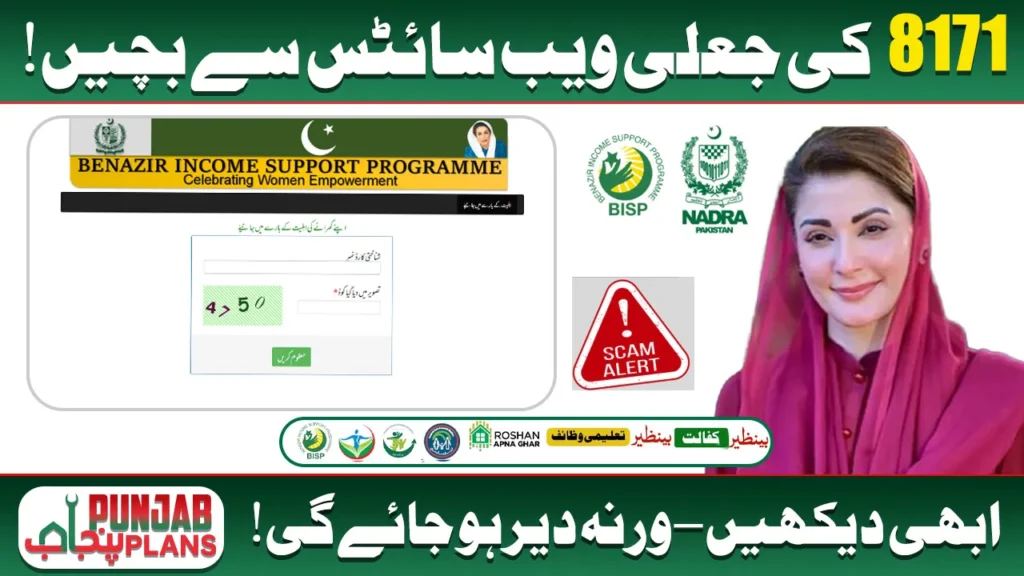
- Look-alike landing page: Uses national flag colors, BISP logos, photos of leadership, and “8171” to appear official.
- Data grab form: Asks for CNIC, mobile number, mother’s name, or OTP from your phone.
- OTP interception: You’re tricked into sharing one-time codes, enabling SIM swaps or wallet access.
- Money drain: Funds disappear from your mobile account or bank; sometimes your SIM gets re-issued to the attacker.
Red Flags: How to Spot a Fake BISP 8171 Site in Seconds
- Suspicious domain name: Misspellings (b1sp, benazlr, 8171-pk, etc.) or domains ending in .com, .fun, .xyz, .online pretending to be official.
- No HTTPS lock: Missing the padlock icon or showing “Not Secure” in the address bar.
- Aggressive pop-ups: “Only 5 minutes left! Enter CNIC now.” Real government portals don’t use countdown tricks.
- Unrealistic promises: “Instant cash,” “no eligibility checks,” or “double payment bonus.”
- OTP requests: Never share one-time passwords or PINs on a website.
- Payment requests: Government programmes do not ask for “processing fees” or “portal charges.”
- No verifiable contact: Fake pages hide behind contact forms, Telegram/WhatsApp-only numbers, or broken email links.
- Grammar & logo issues: Low-quality Urdu/English, stretched logos, old photos, or inconsistent branding.
The Safe Way to Check BISP Eligibility in 2025
Use only official channels published by BISP on verified government domains (commonly .gov.pk) or through official SMS codes announced by BISP. If you didn’t find the method directly on an official BISP page or a verified government announcement, don’t use it.
1) Use the Official BISP Web Portal
- Access the portal from a government domain (look for .gov.pk) via your browser.
- Type the known official URL manually or use a search engine to find “site:.gov.pk BISP 8171” and click only government results.
- On the portal, you may be asked to provide minimal details (e.g., CNIC and a simple captcha).
- Do not enter OTPs, mobile wallet PINs, or card details those don’t belong in eligibility checks.
2) Official SMS (When Announced by BISP)
- BISP has historically used the short code 8171 for information. Only send your CNIC to the exact official short code announced by BISP not to look-alike numbers.
- Be cautious of texts from regular mobile numbers pretending to be “BISP 8171 support.”
- Never share OTPs or PINs in reply to messages.
3) Local BISP Offices & Helplines
- If you’re unsure, visit your nearest BISP Tehsil Office or call the official helpline listed on a government site.
- Staff can confirm whether you’re eligible, the correct portal, and the latest disbursement schedule.
How to Protect Your CNIC & Phone
Your CNIC is the key to your identity across banks, SIMs, and services. Guard it like cash.
- Share less: Only provide CNIC on government portals or in-person at official BISP centers.
- Lock your SIM: Set a SIM PIN (PUK/PIN from your operator) and enable account-level security with your mobile network.
- Use strong phone security: Set a device passcode, biometric lock, and disable app installations from unknown sources.
- Enable SMS filters: Many phones can filter unknown senders or flag suspicious links.
- Beware of “support” calls: Scammers will claim to be from BISP or your bank, ask for CNIC + OTP hang up and call the official number yourself.
- Monitor wallets & accounts: Check your mobile wallet/bank frequently; set up transaction alerts.
- Report quickly: If you shared information on a fake site, immediately contact your mobile operator, wallet provider, bank, and file a report at the relevant cybercrime channel (e.g., FIA’s cybercrime wing).
Frequently Asked Questions (FAQs)
Final Thoughts
Staying safe online is just as important as checking your BISP eligibility. Always use the official .gov.pk portal or the verified 8171 SMS code. Avoid sharing your CNIC, OTP, or bank details on unknown websites. If something looks suspicious, stop and double-check before entering any information. Protecting your CNIC means protecting your family’s future.